Agentic AI and the future of continuous cyber defense

Security teams are not short of alerts. They are short of time to deal with them. Every new tool adds another stream of warnings, most of them harmless, and the one that matters can sit in a queue for hours while analysts work through the rest.
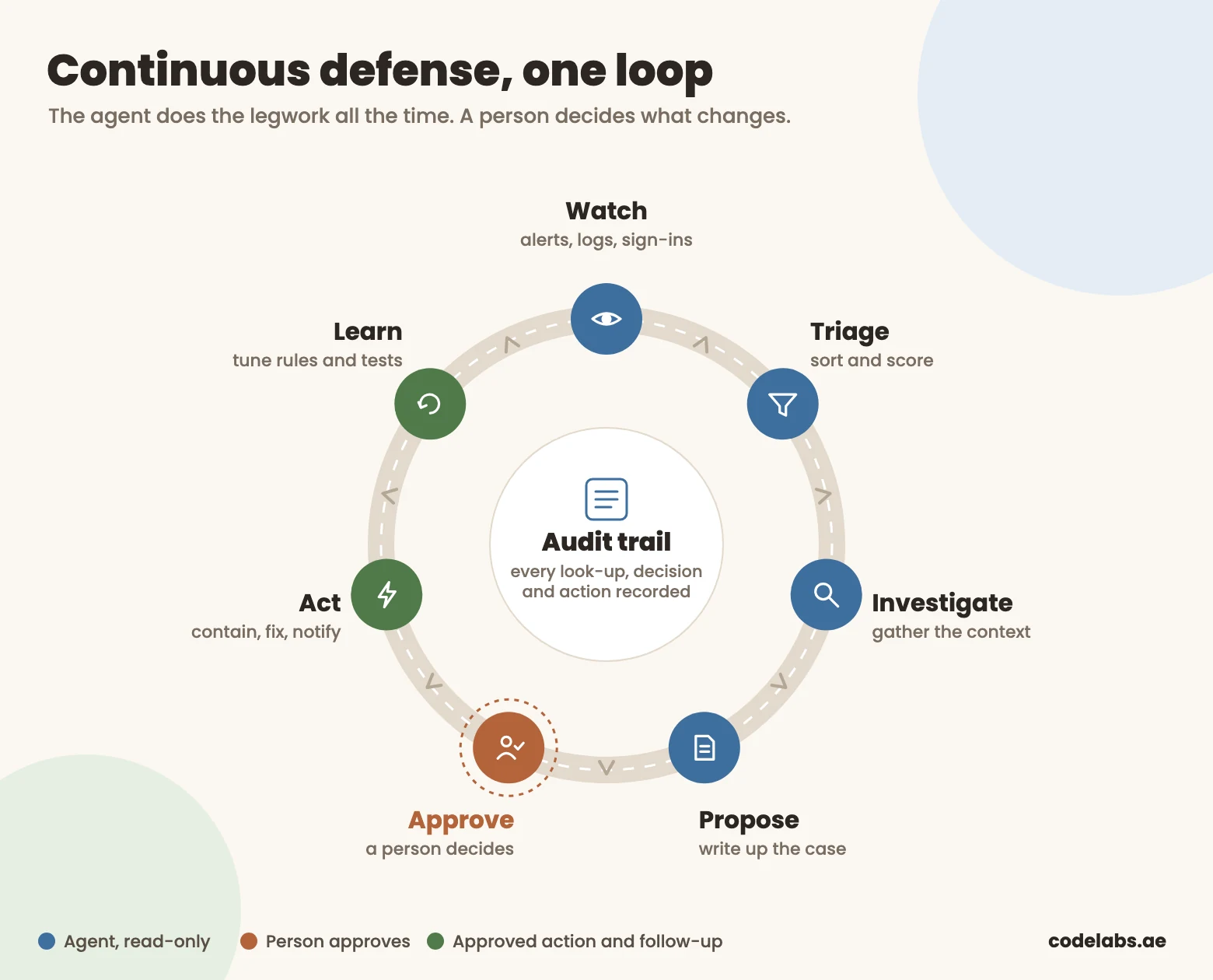
Agentic AI changes what software can do with that queue. A traditional tool detects and raises an alert. An AI agent can pick the alert up, gather the context an analyst would look for, decide how serious it is, write up what it found and propose the next step, then wait for a person to approve anything that changes a system. Defense stops being something that happens when someone gets to the queue and becomes something that runs all the time.
This article explains what agentic AI is, how continuous cyber defense is moving beyond traditional tools, where agents are useful today, and what to check before you let one near your security operations. It draws on how we built ChannelHub, our multi-agent platform, because the controls that make an agent trustworthy with customers are the same ones a security team should insist on.
What agentic AI is, and why it matters for security teams
A chatbot answers questions. An AI agent takes steps: it plans, calls tools, reads what comes back and decides what to do next, within limits you set. Our guide to AI agents vs chatbots covers the difference in detail.
For security, the step-taking is the point. Much of an analyst's day is the same sequence repeated: look up the user, check the device, search the logs for the same indicator, compare against threat intelligence, then decide whether to escalate. An agent can do that legwork in seconds and hand the analyst a finished case instead of a raw alert.
The stakes are real. IBM's Cost of a Data Breach Report 2026 puts the global average cost of a breach at USD 4.99 million, a record high, and reports that organisations using security AI and automation extensively saved USD 1.93 million compared with those using none. Time matters here: the longer an attacker goes unnoticed, the more they can reach.
How continuous cyber defense is moving beyond traditional tools
Most security stacks were built in layers: a firewall, endpoint protection, a SIEM collecting logs, perhaps a SOAR platform running fixed playbooks. Each layer is good at its own job. The gaps are between them, and people fill those gaps by hand.
- Rules catch what you anticipated. Signatures and correlation rules are precise, but an attacker using valid credentials in an unusual way often triggers nothing, or something that looks routine.
- Fixed playbooks break on the unexpected. A SOAR playbook follows the branches someone wrote. When the alert does not fit, it stops and waits for a person.
- Periodic reviews leave long gaps. Quarterly access reviews and annual tests show how things looked on the day, not how they look now.
Continuous defense means watching, checking and responding all the time, not on a schedule. Agents fit this because they can reason over messy, incomplete information the way an analyst does, and they do not get tired at 3 a.m. They do not replace the detection tools; they work across them, reading from each one and connecting what they find.
Practical use cases you can start with
The best first uses are high in volume, tedious for people and safe to automate because the agent only reads and recommends. Six that fit most organisations:
- Alert triage and enrichment. The agent takes each new alert, pulls the user, device, recent sign-ins and related log entries, checks indicators against threat intelligence, and writes a short summary with a suggested severity. Analysts start from a case, not a blank screen.
- Phishing report handling. When staff forward a suspicious email, the agent inspects the headers, links and attachments in a safe environment, checks whether others received the same message, and either closes it with an explanation or escalates it with the evidence attached.
- Vulnerability prioritisation. Scanners produce long lists. The agent ranks findings by what is actually exposed, whether an exploit is circulating and how important the affected system is, so the team patches what matters first.
- Identity and access anomalies. Impossible travel, a dormant account waking up, or a user suddenly reaching systems they never touch: the agent investigates the pattern and explains why it looks wrong, or why it does not.
- Continuous configuration checks. In cloud environments the agent can compare live settings against your baseline every day and raise drift as it happens, such as a storage bucket made public or a security group opened to the internet. Our cloud security work covers the baseline itself.
- Incident write-ups and updates. During an incident, the agent keeps the timeline, drafts status updates for management and records every action taken, so the people responding can focus on the response.
Notice what is missing from the list: blocking accounts, isolating machines or changing firewall rules on the agent's own decision. Those come later, if at all, and always with a person approving.
What we learned building ChannelHub
ChannelHub is not a security product. It is the multi-agent platform we built to run AI agents on WhatsApp, web chat and API for businesses, connecting them to the systems those businesses already use. But running agents that act on real systems taught us which controls make them safe to trust, and every one of them applies to security operations.
- Record everything. In ChannelHub every routing decision, retrieval and tool call is recorded, so any answer can be explained afterwards. A security agent needs the same: an analyst, an auditor or an incident review must be able to see exactly what the agent looked at and why it concluded what it did.
- Cite the source, or say you do not know. ChannelHub's agents answer from a business's own documents and say when they lack a source instead of guessing. In security, a confident wrong answer is worse than no answer. Findings should point to the log line, the alert or the intelligence they came from.
- Hand over with the full context. When a ChannelHub agent cannot help, the conversation goes to a shared queue and the person picking it up sees everything that happened. A security agent should escalate the same way, with the evidence gathered, so no one starts the investigation again.
- Connect to what already exists. ChannelHub calls a business's existing APIs instead of replacing its systems. Security agents should work through your current SIEM, endpoint and identity tools, not ask you to rebuild the stack around them.
We cover the day-to-day side, from monitoring to cost control, in running AI agents in production.
Key considerations before you adopt it
- Least privilege for the agent itself. Give it read access to begin with and a separate, narrow set of actions later. An agent is a powerful new identity in your environment; treat its credentials like an administrator's.
- Prompt injection is your new attack surface. A security agent reads attacker-controlled content all day: phishing emails, malicious web pages, crafted log entries. The OWASP Top 10 for LLM applications lists this first, as LLM01:2025 Prompt Injection, including indirect injection through external content. Treat everything the agent reads as data, never as instructions, and make sure no single piece of content can trigger an action.
- A person approves anything irreversible. Containment, account changes and deletions go through human approval, with the agent's reasoning and evidence in front of the approver.
- Know where your data goes. Logs contain personal data and sensitive details about your systems. Decide which model provider and hosting region are acceptable, and check what your sector's regulator expects, before any logs leave your environment.
- Measure it like any other control. Track time to triage, time to contain, false positives closed correctly and escalations the analysts disagreed with. If the numbers do not improve, change the setup or stop.
- Start narrow. Pick one queue, such as reported phishing, run the agent alongside your analysts for a few weeks and compare results before widening its scope.
Questions people ask
Will agentic AI replace security analysts?
No. It takes over the repetitive gathering and summarising that fills an analyst's day, so people spend their time on judgement: deciding what an incident means, what to do about it and how to stop it happening again. The aim is for the same team to handle more incidents, better, not to run with fewer people.
Is it safe to let an AI agent take action on its own?
Only for narrow, low-risk, reversible steps that you have tested, and only with every action recorded. Anything that affects users or systems, such as disabling an account or isolating a laptop, should wait for a person to approve it. Most of the value comes from investigation, not from autonomous action.
Where should we start?
Choose one high-volume, low-risk workflow, usually alert triage or reported phishing. Give the agent read-only access to the tools involved, make sure every step is logged, and measure the results against your current process for a month. Our agentic AI team can help you scope that first agent and run it safely through agent integration and operations.