Agents built around your actual workflows and knowledge base, not a generic chatbot template.







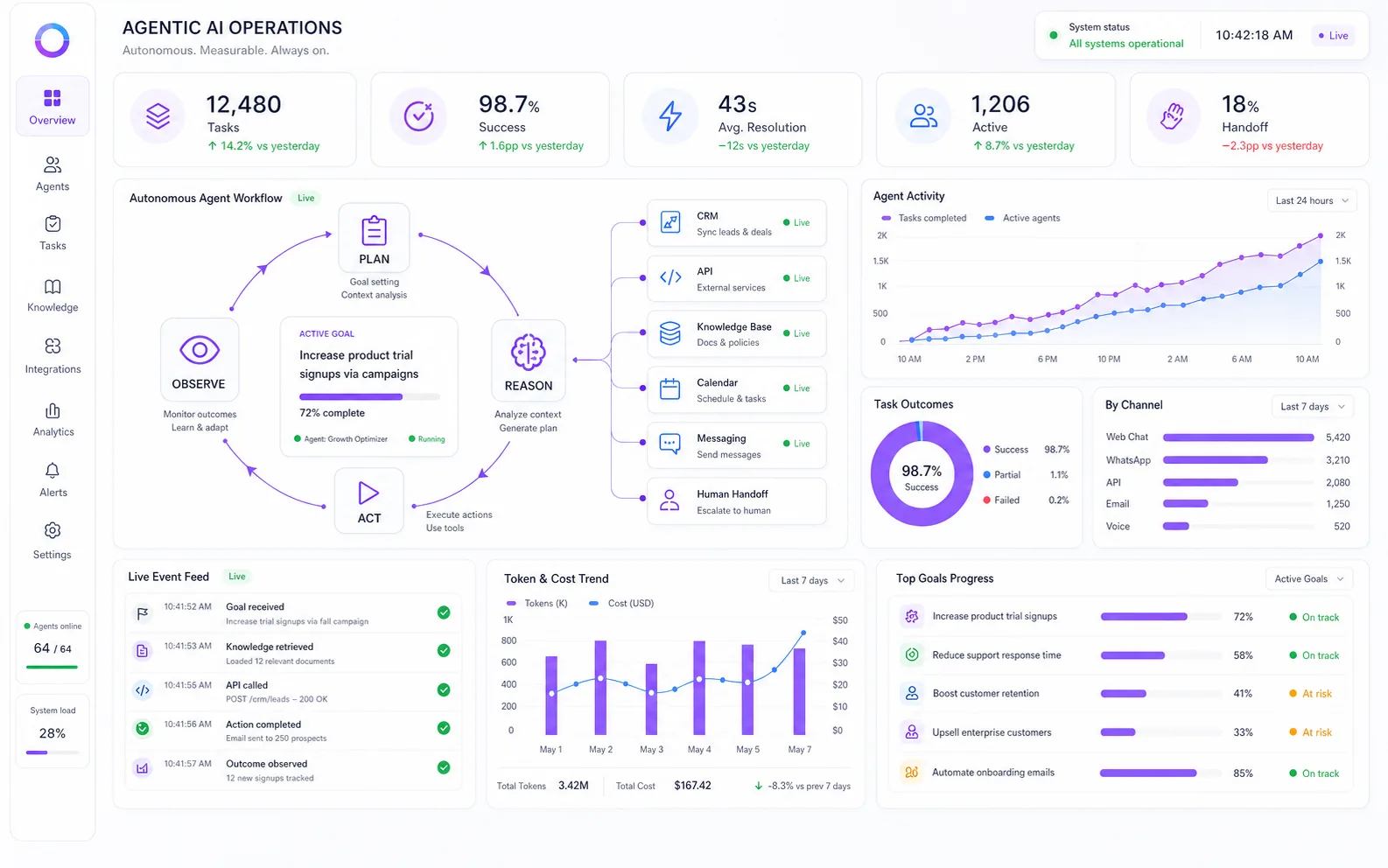
CodeLabs' own in-house multi-channel AI agent, live on codelabs.ae today — handling real conversations across WhatsApp, web chat and API, qualifying leads in multiple languages before routing them to sales.

Agents built around your actual workflows and knowledge base, not a generic chatbot template.

One agent definition, deployed to WhatsApp, web chat and API without rebuilding logic per channel.

Agents that call your real tools and APIs to complete tasks, not just answer questions.

Every conversation, tool call and token metered against a live spend dashboard.
Most people arrive at this looking for a chatbot. It is worth being clear about what the difference actually is, because it decides what you should buy.
A chatbot follows a script. You map out the questions customers ask, write the answers, and connect them with buttons or keyword matching. Ask it something the script does not cover and it either guesses badly or hands you to a human. For a narrow job — opening hours, order status, a simple FAQ — that is often genuinely all you need, and it is cheaper to build.
An agent is not working from a script. It understands what was asked in open language, retrieves the answer from your actual knowledge base, and can call your systems to complete the task — check the stock level, book the slot, raise the ticket, send the payment link. The test is simple: a chatbot can tell a customer your returns policy; an agent can start the return.
If your questions are few, fixed and rarely change, a chatbot is the honest answer and we will tell you so. An agent earns its cost when the questions are open-ended, when the answer lives in a system rather than a document, or when your team is manually doing something after every conversation. That last one is usually the tell.
In the UAE and Pakistan, most of this traffic is WhatsApp, not web chat — which is why we build on the WhatsApp Business API rather than treating it as an afterthought. One agent definition deploys to WhatsApp, your website and your own systems over API, so you are not maintaining three separate bots that drift apart.
Every reply, tool call and token is metered against a live dashboard. The build is a one-off; the running cost scales with adoption, and you should be able to see it before it surprises you. We would rather show you that number early than have the conversation after the first invoice.







An agent isn't a one-time build — we keep it accurate, monitored and expanding as your business changes.

We keep your agent's knowledge sources current as your services, pricing and policies change, so answers stay accurate over time.
Ongoing visibility into conversations, tool calls and AI spend, so cost scales predictably as adoption grows.

Real transcripts reviewed regularly to catch weak answers, missed intents and opportunities to tighten the agent's responses.

New tools and systems connected over time as your agent's responsibilities grow beyond its initial scope.


The website is fabulous and we truly appreciate the effort, trouble-shooting and support you’ve extended towards us. I must also confess that you head a highly professional team and the credit of course goes to you. I don’t say this lightly as I’ve worked with several diverse outfits!

CodeLabs has been a great partner developer for HumWell’s products. This was its first go in the healthcare sector and they did an exceptional job. There was a lot of back and forth to come to a delicate balance between HumWell’s expectations and CodeLabs’s experience in making those expectations a reality. CodeLabs’s team is always open to new ideas and willing to provide their advice to steer the flow in the right direction. It is an ongoing process in which a mutual understanding has helped and HumWell’s Product team looks forward to a continuous collaboration with CodeLabs in the years to come.
We contracted CodeLabs to build our IoT-enabled cloud eco-system connected with mobile apps and external CRMs to streamline business operations. The team delivered on time and within budget. They also have an in house UI/UX team that ensures the design of each software asset matches that of the client's branding objectives.
The overall experience was good with the CodeLabs team and in a nutshell, they are not only service providers but also your technology consultants or partners.
Since “The Darzee” is a bespoke tailoring solution, there were so many complications that were supposed to be taken into consideration before & during the project initiation. We were impressed by CodeLabs as they could build something so user friendly out of such a complex model.

From day one, we realized their sense of responsibility and passion towards us and our project. The results produced and generated from the application were up to the mark with no big hurdles and bottlenecks were surfaced after the launch.
After launch, an AI agent is an operations job: traces, tests before every change, cost caps, fallbacks and a person reading conve…

Automation succeeds or fails at the handoff: which support requests to automate, when to hand over to a person, and what to pass a…

The five checks to run before a software project starts, how to test whether requirements are feasible, and what the report should…


Common questions about building and deploying AI agents.
Both. We built and operate ChannelHub, our own multi-channel messaging and agent platform. CodeLabs BOT runs on it and is live on codelabs.ae's chat right now, handling real multilingual conversations — so the platform we would deploy your agent on is one we already carry the pager for.
WhatsApp, web chat and API from a single agent definition — you're not maintaining separate bots for each channel.
Every reply, tool call and token is metered against a live dashboard, so you can see exactly what usage is costing as adoption scales — not a surprise bill at the end of the month.
Yes. Agents are built to call your real APIs and reference your actual knowledge base, so they can complete tasks and answer questions grounded in your business, not generic training data.
It says so and hands over, rather than inventing something. You decide where that hand-off goes — a human on WhatsApp, a ticket in your helpdesk, or a callback request — and the conversation history goes with it, so nobody has to start again.
You own it. Conversations, customer records and the knowledge base you supply remain yours, and we will tell you exactly which region they are stored in and which model providers see what. If you need them held in a specific jurisdiction, say so at the start — it shapes the architecture rather than being bolted on later.
Get valuable consultation from our professionals to discuss your project. We are here to help you with all of your queries.