What should never be automated?

In conversations about AI, the same question keeps coming up: what can we automate next? It is a fair question. The tools are cheap, they improve every few months, and the list of things software can now do on its own grows every week.
But I think it is the wrong question to start with. The better one is the opposite: what should never be automated? Answer that first, honestly, and everything else becomes easier to decide. Skip it, and you end up automating something you will spend months undoing, along with the trust you lost in the process.
This is not an argument against automation. We build AI agents and automation for a living, and I believe in them. It is an argument for drawing the line on purpose, before the technology draws it for you.
Why "what next?" is the wrong default
When automation was expensive, the cost kept us careful. Every workflow had to justify a project, a budget and a team, so only the obvious candidates got automated. That brake is gone. Today an agent can be connected to your email, your CRM and your payment system in an afternoon.
When the cost of automating anything drops to almost nothing, the limit is no longer what is possible. It is what is wise. "Can we?" is now nearly always yes. "Should we?" is the question that needs an owner.
A five-question test
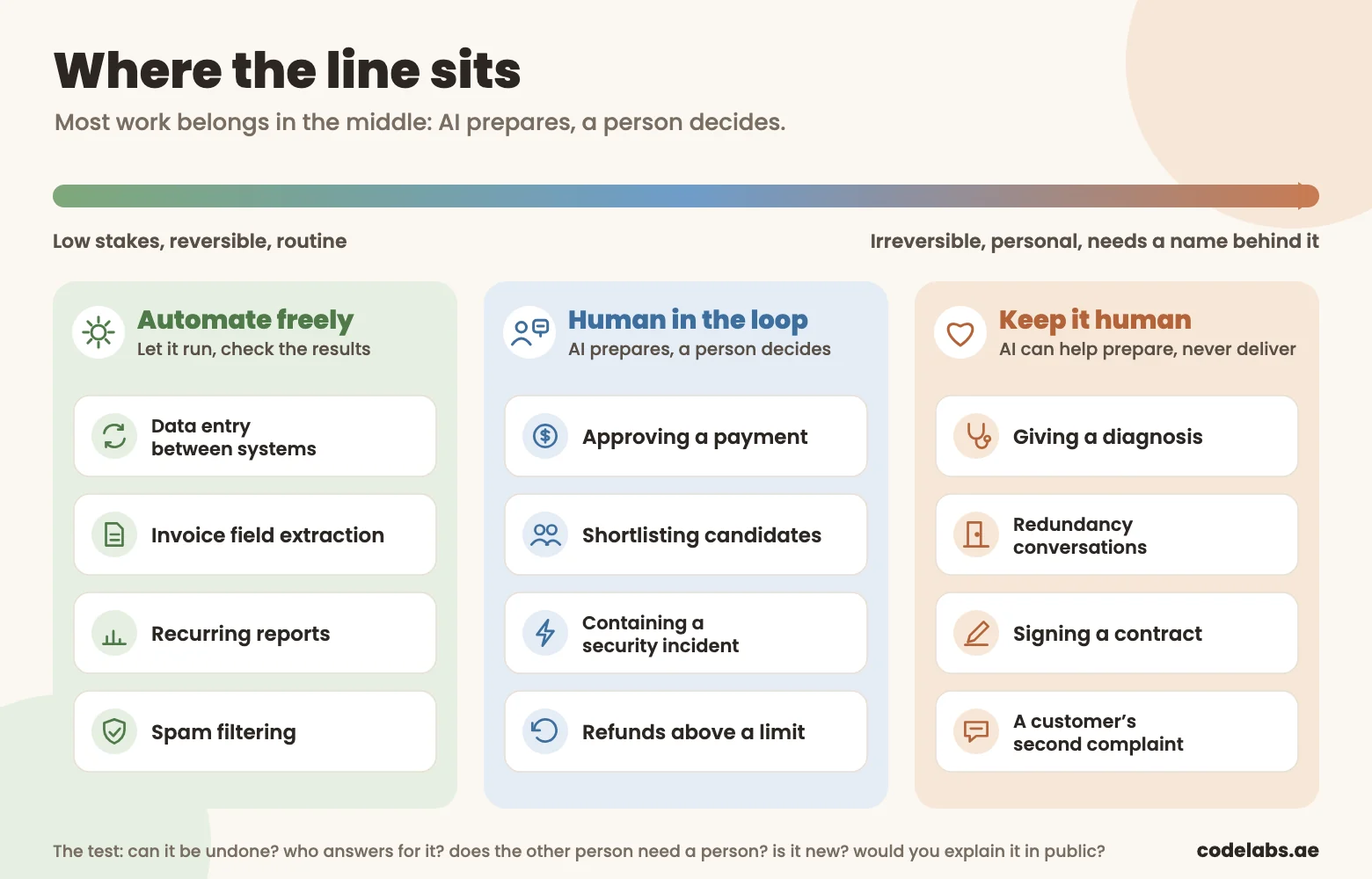
Here is a simple test: five questions for every step you are thinking of automating. If a step fails any of them, it stays with a person. AI can still help that person, but it does not decide.
1. Can it be undone?
Sending money, deleting records, signing a contract, telling a customer their claim is rejected. If a mistake cannot be reversed cleanly, the final step needs a person. Automate everything up to the button, not the button itself.
2. Who answers for it?
Every decision that affects someone's job, health, money or legal position needs a name behind it: a person who can explain it, defend it and change it. "The system decided" is not an answer anyone should accept, and in many places it is not one the law accepts either. Under GDPR Article 22, people have the right not to be subject to a decision based solely on automated processing that produces legal or similarly significant effects on them.
3. Does the person on the other end need a person?
Some moments carry weight that has nothing to do with efficiency. Bad news about a diagnosis, a redundancy, a declined application, a complaint from someone who has already been let down twice. An instant, polished, automated reply in those moments does not feel efficient to the person receiving it. It feels like being processed.
4. Is the situation new or ambiguous?
Automation is excellent at the cases it has seen before and poor at the ones nobody anticipated. When the facts are unclear, the stakes are high and the right answer depends on context that is not in any system, that is judgement. Judgement is still a human job.
5. Would you be comfortable explaining it in public?
Imagine the decision, and how it was made, described on the front page of a newspaper. If the honest description makes you wince, such as "an algorithm screened out applicants over 45" or "refunds were refused automatically unless the customer complained twice", the problem is not the technology. It is that this step should never have been handed to it.
"Never automated" does not mean "no AI"
This is where many conversations go wrong. Keeping a decision human does not mean keeping AI out of it. In practice, the most valuable pattern is in the middle: AI gathers the facts, drafts the options and flags what looks unusual, and a person makes the call with all of that in front of them.
- A recruiter gets every application summarised against the role, but a person decides who is rejected.
- A clinician gets the patient's history and relevant notes pulled together, but the clinician makes the diagnosis.
- A finance team gets invoices matched and exceptions highlighted, but a person approves the payment.
- A security team gets each alert investigated and written up, but a person approves any action that changes a system.
The person is faster, better informed and less buried in routine work. The decision is still theirs.
How we apply it in what we build
We hold ourselves to the same test. A few examples from our own systems:
- The assistant on this website answers questions from our own pages and takes enquiries, but it does not quote prices beyond those we publish, agree terms or make commitments. Quotes and contracts come from a person on our team.
- Our enquiry screening uses AI to label every message sent through our contact form as legitimate, uncertain or likely spam. But every enquiry still reaches the team, whatever the label says. The AI helps us decide what to read first; it never decides what we see.
- The agents we build on ChannelHub, our multi-agent platform, hand a conversation to a person the moment they cannot help or a customer asks for one, with the full conversation passed along. For anything irreversible, our advice to clients is the same as in this post: let the agent prepare it and a person approve it.
We wrote about where automation pays off first in AI workflow automation: five processes to automate first, and about keeping people in charge of security agents in agentic AI and continuous cyber defense. This post is the other half of the same idea.
The question to ask in every project
Before the next automation project starts, put one item at the top of the agenda: list the steps that will never be automated, and say why. It takes ten minutes. It will shape the design more than any technology choice, and it is the best protection you have against the kind of automation that saves money for a quarter and costs trust for years.
If you are planning an agent or an automation and want a second opinion on where the line should sit, our agentic AI team is happy to help you draw it.
Questions people ask
Isn't keeping a person in the loop just slowing things down?
Only if the person has to do all the work. When AI prepares the case and the person reviews it, the human step often takes seconds. What it adds is accountability and a chance to catch the mistake that would have cost far more than the time saved.
Will the line move as AI improves?
Some of it will. Tasks that fail the "is it new or ambiguous?" question today may pass it in a few years. But the questions about accountability, dignity and reversibility are not about what the technology can do. They are about what we want to be responsible for, and those answers change much more slowly.