Choosing an agentic AI provider in the UAE: questions to ask first
Every agentic AI demo looks good. The agent answers a few prepared questions, books a meeting, updates a record, and the room nods. The trouble comes later: the unusual request nobody scripted, the bill at the end of the month, the wrong answer that goes out and is never noticed.
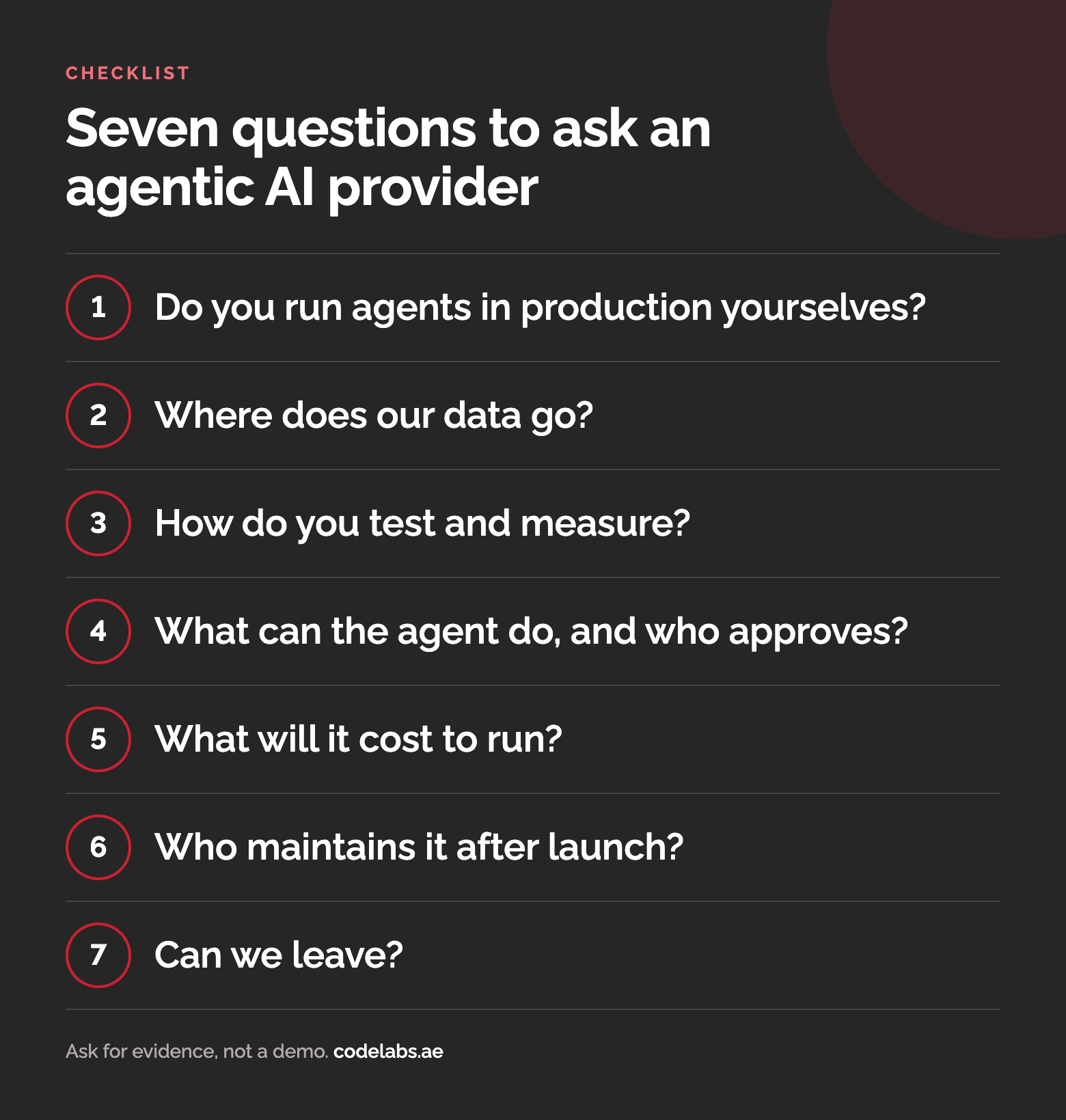
So before you choose an agentic AI provider in the UAE, ask seven questions. Start with the one that matters most: do they run agents in production themselves? Then ask where your data goes, how the agent is tested, what it is allowed to do, what it costs to run, who maintains it after launch and whether you can leave. The answers separate the firms that have operated an agent from the ones that have only built a demo.
We build agentic AI for businesses in the UAE and Saudi Arabia, and buyers put these questions to us. Each section below says what to ask and what a good answer sounds like.
Demo vs production
A demo runs on questions the provider chose. Production runs on whatever your customers type. Four things only show up once an agent is live:
- Edge cases. People switch language mid-sentence, change their mind halfway through, or ask for something the agent was never meant to handle. Ask what the agent does when it does not know. The right answer is that it says so and hands the conversation to a person, with the history attached.
- Running cost. Every reply uses a paid language model. A cost that looks trivial in a demo behaves differently at ten thousand conversations a month.
- Monitoring. Somebody has to be able to see what the agent said yesterday, and be told when it starts failing.
- Security. An agent that can call your systems is a new way into them. Its permissions need the same care as a new employee's.
The seven questions turn those four into things you can ask in a meeting.
Do you run agents in production yourselves?
This is the most useful question on the list. A provider that operates its own agent has already met the problems you are about to meet. Ask to talk to that agent. Ask how many conversations it handled last week, what that cost, what went wrong most recently and how they found out.
Our answer is ChannelHub, the multi-agent platform we built and now run as a product with its own customers. The assistant on this website runs on it. It answers in English, Urdu and Arabic, asks for a name and a contact number, and passes enquiries to our sales team. In a recent seven-day window it handled 152 messages across 15 conversations, and the AI spend for the week was $0.94. The ChannelHub case study has the detail.
Those are small numbers. The point is that we can tell you exactly what they are.
Where does our data go?
An agent sends your customers' messages to a language model and usually stores the transcripts. Ask which model provider is used, which country or cloud region the data is processed and stored in, how long transcripts are kept, who can read them, and whether your data is used to train anyone's models.
In the UAE this is a legal question as well as a technical one. The federal data protection law (Federal Decree-Law No. 45 of 2021) covers personal data on the mainland, the DIFC and ADGM free zones have their own data protection laws, and health data carries a stricter rule: it generally may not be stored or processed outside the country without the health authority's permission. The government's summary of UAE data protection laws is a good place to start, and your legal counsel should confirm what applies to you.
A good provider answers with a diagram showing where each kind of data goes, and a retention period in writing. If you need data held in a particular jurisdiction, say so at the start. It shapes the architecture, and it is hard to add later.
How do you test and measure?
Ask to see the test set: a list of real customer questions with the answers the agent is expected to give. Agree an accuracy target on that set before the build starts, and ask whether the whole set is run again before every change to the prompts, the knowledge base or the model. An agent that passed its tests in March can fail them in June after one small edit.
Then ask what is measured once it is live: how many conversations were answered correctly, how many were handed to a person, and how many went wrong. A provider that reviews real transcripts regularly will know those numbers without looking them up.
What can the agent do, and who approves?
An agent that only answers questions carries limited risk. An agent that acts, by issuing a refund, changing a booking or updating a customer record, needs rules. Ask for a list of every action it can take, the system permission behind each one, and which actions wait for a person's approval.
A sensible first version reads information freely, takes low-risk actions on its own, and asks a person before anything that moves money or cannot be undone. Every action should be logged, so you can see afterwards what the agent did and why.
Ask too how the agent treats instructions that arrive inside the content it reads. An email, a document or a web page can contain text written to redirect an agent. A well-built agent treats that text as information, not as orders.
What will it cost to run?
There are two costs: building the agent and running it. The running cost is model usage, the platform, and the people who maintain it. Ask for the expected cost per conversation at your volume, what happens if volume grows tenfold, and whether you can set a monthly cap with an alert before it is reached.
For scale, the $0.94 our own assistant spent on AI in that week works out at about six US cents a conversation. Yours will differ: longer conversations, a larger knowledge base and more calls to other systems all raise it. What matters is that the provider can show you the figure on a dashboard at any time, not estimate it at the end of the month.
Who maintains it after launch?
An agent starts going out of date the day it launches. Your prices and policies change, customers start asking new things, and model providers update and retire the models underneath it. Ask who reviews the conversations, who keeps the knowledge base current, what happens when the model changes, and what the support agreement includes.
A good answer names a person, a review routine and a regular report. This is the work we describe on our agent integration and operations page, and it is the part of a proposal that is easiest to overlook.
Can we leave?
Ask who owns the prompts, the knowledge base, the conversation history and the integration code, and whether you can export all of them. Ask what happens to your data when the contract ends, and whether the agent is tied to one model provider.
The answers belong in the contract. A provider confident in its work has no reason to make leaving difficult.
Red flags
- The demo works on their questions but not on yours.
- They have no live agent of their own to show you.
- They say the agent does not make mistakes, and have no plan for when it does.
- They cannot tell you which model is used or where your data is stored.
- There is no estimate of the running cost.
- The proposal ends at launch.
- They promise an accuracy figure before they have seen your data.
Questions buyers ask
Should we choose a local or an international provider?
Where the provider is based matters less than whether they can meet your data requirements, support your languages and be reached during your working hours. A provider in the region is more likely to know the UAE's data rules and to have built for Arabic. Put the same seven questions to both, and insist on a named person who stays responsible after launch.
Can the agent work in Arabic?
Yes. Current language models handle Modern Standard Arabic well, and many cope with Gulf dialects and with messages that mix Arabic and English. Quality varies, so test with your customers' real messages before launch. Check the knowledge base too: if the source documents exist only in English, the Arabic answers depend on translation.
How long does a first agent take?
It depends on what the agent has to connect to. An agent that answers from an existing knowledge base on one channel is the quickest to launch. Each system it has to act in, such as a booking system, a CRM or a payment provider, adds integration and testing time. Ask for a plan that starts with a pilot on a small share of real conversations, then widens.
If you would like to put these questions to us, start with the assistant on this page, which runs on the platform described above, or read how we build AI agents for WhatsApp, web and API.