Healthcare mobile app development: features, integrations and data rules
A healthcare app succeeds or fails on one thing: whether a patient can get from opening it to a confirmed appointment, a consultation or a test result without phoning anyone. That depends less on the screens than on what sits behind them: live connections to the hospital's scheduling and records, careful handling of health data, and a design that works for an elderly patient on a mid-range phone.
This guide covers what to build first, the integrations that decide whether the app works, the data rules for apps used in the UAE, and how to design for every kind of patient. It draws on the healthcare apps we have built, including LNH Care, the appointment app for Liaquat National Hospital in Karachi.
Three kinds of healthcare app
"Healthcare app" covers very different products, and it helps to name which one you are building:
- Patient apps. Find a doctor, book, pay, attend a video consultation, see results. These are used occasionally, often by people who are unwell or worried, so they have to be obvious at first sight.
- Clinician apps. Schedules, patient lists, notes, results and messages. These are used many times a day under time pressure, so speed matters more than extra features.
- Operations tools. The panels where front-desk and call-centre staff manage doctors, slots, fees and bookings. These are usually web applications rather than mobile apps.
Most projects need two of these at once. A patient booking app is only as good as the admin panel behind it, so plan both from the start.
Features to build first
For a patient app, start with the journey patients repeat most often, which is usually booking:
- Find a doctor three ways: by name, by department, or by the soonest available slot. Patients search all three ways, so none should be hidden in a filter.
- Live availability and booking, with the consultant, timing and fee shown before the patient confirms.
- Payment, and insurance details where the provider bills insurers.
- Reminders and easy rescheduling, because a missed appointment is a slot nobody else could use.
- Booking for someone else. Family members and attendants often book on a patient's behalf.
- Video or chat consultations, if the service offers them.
- Results, prescriptions and visit history, once the records integration is in place.
- The right languages: Arabic and English in the UAE and Saudi Arabia, English and Urdu in Pakistan.
Launch with booking working end to end, then add consultations and records. A small app that always works earns more trust than a large one with gaps.
The integrations that decide whether it works
A healthcare app shows what the hospital's systems say. If it offers a slot that was taken an hour ago, or a fee that differs from the one at the counter, patients stop trusting it. The connections usually needed are:
- Scheduling or the hospital information system, for live slots, fees and cancellations.
- The electronic medical record, for results, prescriptions and visit history, usually read-only for patients.
- A payment gateway, reconciled with the hospital's billing.
- Insurance, for checking cover and approvals where the provider bills insurers.
- Notifications by push, SMS or WhatsApp.
- A video service for teleconsultations.
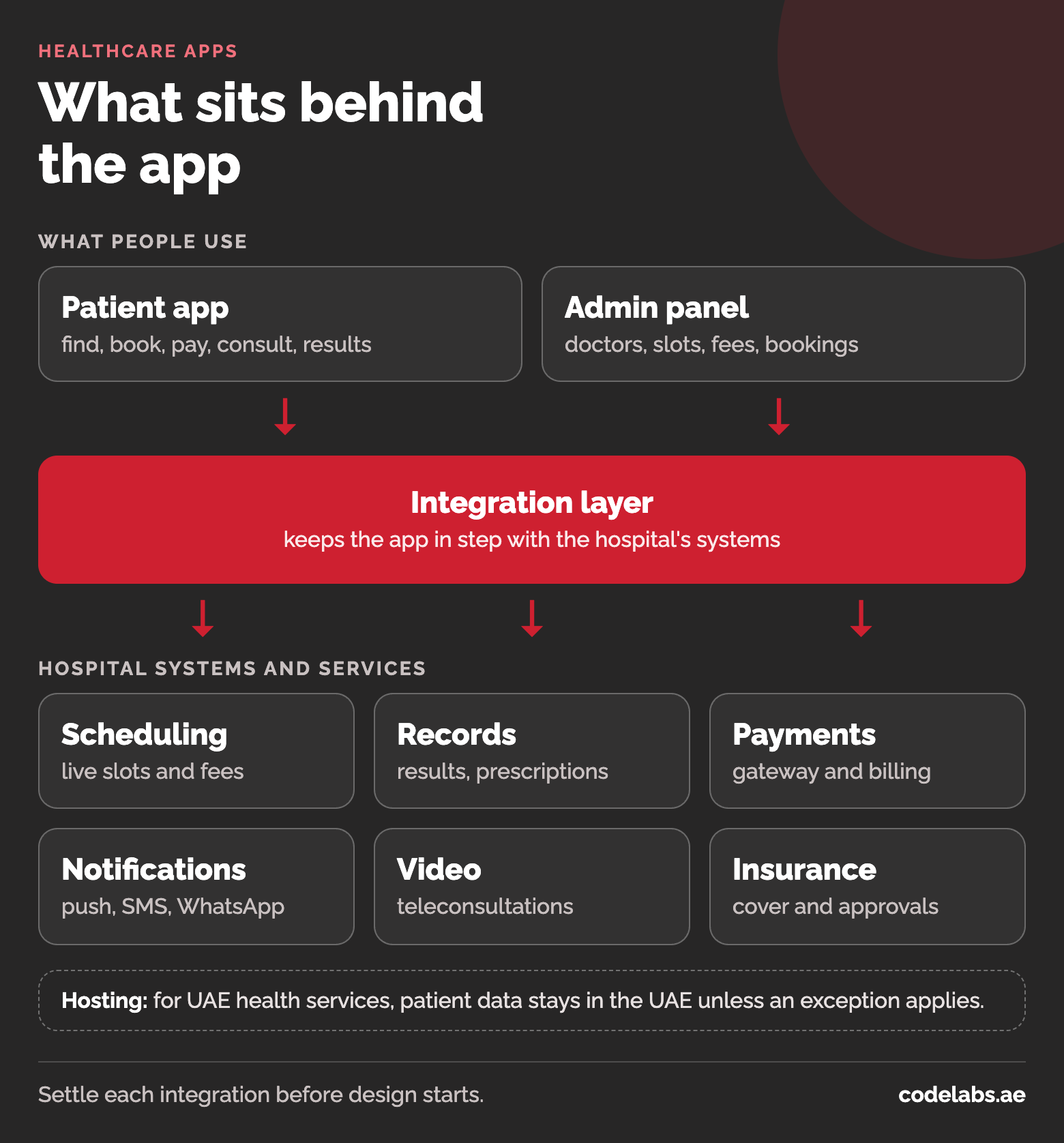
Before design starts, find out whether each system has an API, who owns it, what access costs and whether there is a test environment. The answers set the timeline more than the number of screens does.
Health data rules in the UAE
Health information is among the most sensitive data an app can hold, and the UAE regulates it with its own law. This is a summary, not legal advice, so confirm the details for your case with the regulator or a lawyer.
- Federal Law No. 2 of 2019 on the use of ICT in health fields applies across the UAE, including the free zones. Its Article 13 requires health data relating to health services in the UAE to be stored and processed inside the country, unless an exception applies. Ministerial Resolution No. 51 of 2021 lists those exceptions and their conditions.
- In practice, host a UAE app's patient data in a UAE region, and check where every third-party service stores its data: video, messaging, analytics and crash reporting included.
- In Abu Dhabi, the Department of Health's Healthcare Information and Cyber Security Standard (ADHICS) is mandatory for healthcare facilities, and its current version also covers the technology providers that handle their health data. In Dubai, the Dubai Health Authority sets the requirements for facilities it licenses.
- The app stores have their own rules. Apple's App Review Guidelines (5.1.3) bar apps from using health data for advertising and from storing personal health information in iCloud.
- Some apps count as medical devices. An app that diagnoses, recommends treatment or interprets readings can be regulated as medical device software; Saudi Arabia's SFDA, for example, publishes guidance on which digital health products count. Booking, payments and reminders generally do not.
Design for every patient
Healthcare apps serve a wider audience than almost any other kind of app. For LNH Care, that meant elderly patients, first-time smartphone users and attendants booking for someone else. The brief was a booking a patient could complete in under a minute, on a mid-range Android phone, on a patchy connection. What that led to:
- A calm, high-contrast interface with large text and large tap targets.
- Consultant, department, timing and fee visible before the patient commits, so nothing is a surprise at the counter.
- Short forms that remember details for the next booking.
- A clear way to reach a person when the app cannot help.
LNH Care is live on Google Play and the App Store and has passed 10,000 downloads on Android. For apps in Arabic, the same care applies to language: design right-to-left from the start rather than mirroring an English layout at the end.
Native or cross-platform?
Most healthcare apps need both iOS and Android, because patients use both. For booking, payments and video consultations, a cross-platform app built from one codebase works well and keeps both versions in step: LNH Care ships to both stores from a single codebase. Native development is worth the extra cost when the app depends heavily on the device, such as connecting to Bluetooth medical devices or reading health sensors in the background.
The Humwell telemedicine app, which we designed and built in English and Urdu for iOS and Android, is another example of the patient side: doctor discovery, appointments and virtual consultations in one app.
Launching and running it
- Pilot first with one department or one branch, and fix what real patients find before opening it to everyone.
- Measure the journey: bookings completed in the app, where patients drop out, no-shows, and calls to the helpline that the app should have answered.
- Plan for store review. Health apps get a close look, so prepare the privacy details and a test account before submitting.
- Budget for upkeep. New iOS and Android versions, hospital system changes and new departments all need updates after launch.
If you are planning a healthcare app, our mobile app development page explains how we work, from scoping the integrations to store release.
Questions people ask
How long does it take to build a healthcare app?
It depends mostly on the integrations, not the screens. A booking app connecting to a scheduling system with a ready, documented API is a much shorter project than one where the API has to be built first. We give a timeline after seeing the systems the app has to talk to.
Does patient data have to stay in the UAE?
For health services in the UAE, generally yes. Article 13 of Federal Law No. 2 of 2019 requires health data to be stored and processed inside the country unless one of the exceptions in Ministerial Resolution No. 51 of 2021 applies, each with its own conditions.
Is a healthcare app a medical device?
Only if it does something clinical, such as diagnosing, recommending treatment or interpreting readings. Apps for booking, payments, reminders and video consultations generally are not. If yours might be, check with the regulator before you build.